Collectivism 02: Beyond Boundaries
Landscape architecture begins with a contradiction: every project starts with a boundary line, but no landscape ever ends there.
Every contract arrives with a red line drawn around it – a legal definition of where the work begins and ends. But I find that the longer I spend getting to know a place, the less meaningful that line becomes. As I often tell clients, “The red line around a contract is very different from the systems that we work within.” Water doesn’t stop at a property boundary, and wildlife doesn’t recognize municipal borders – neither do history, culture, or the ways people move through a place. Very quickly, the project grows beyond the site itself.
This paradox is one of the most compelling aspects of landscape architecture. Unlike a building, which can usually be understood as a discrete object, a landscape is a living system. It is constantly shaped by what surrounds it, and in turn shapes everything nearby. Every decision becomes part of a much larger web of relationships.
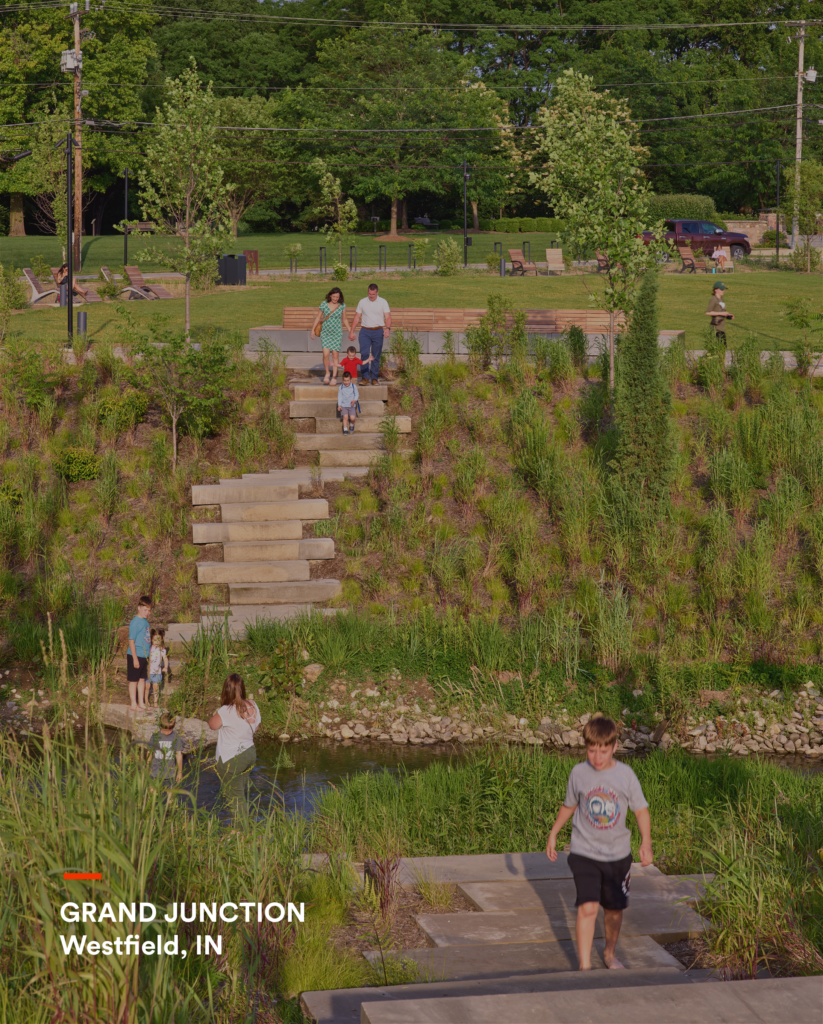
Water is one of the clearest examples. A stream winding through a park might feel like a local feature, but in reality it’s connected to an entire watershed. Everything that happens upstream affects the health of that site, just as decisions made within the project area – how stormwater is managed, how habitats are restored, how the land is graded – will influence everything downstream. Landscape architects must therefore think not only about what exists within the project’s boundaries, but also about the larger system of which it is a part.
The same is true ecologically. Restoring a meadow or planting an urban forest might seem like a small intervention, but those places don’t exist in isolation. They become part of a larger network, helping reconnect habitat, support wildlife, and strengthen ecosystems over time. Even modest projects can have effects that ripple well beyond their immediate footprint.
I think about time in much the same way. Every landscape is layered with decisions made long before we arrive – how the land was used, what was built, what was removed, and whose stories shaped it. Understanding those layers is just as important as imagining what’s next. Every project is an opportunity to carry something forward while leaving future generations with more than they inherited.
The human side of the work follows the same logic. We can design a park to encourage people to gather, linger, or explore, but we can’t script how they’ll use it. Community doesn’t come from design alone; it grows from the interactions that happen once people make a place their own.
That’s why it’s important to think beyond any one audience. The strongest public spaces are the ones where many different people can see themselves reflected. They make room for different ages, abilities, backgrounds, and ways of experiencing the world. Like healthy ecosystems, they become more resilient through diversity.
I’ve found that this way of thinking often changes the conversation with clients. Whether we’re working with a cultural institution, a municipality, or a private developer, the most lasting value usually comes from looking beyond the immediate project. Healthy waterways, connected habitats, welcoming public spaces, and resilient infrastructure don’t just benefit the wider community, but make the place itself stronger over time.
For me, landscape architecture always comes back to the same question: How does this place belong to something larger than itself? The answer is almost always the same. Every site is connected: to watersheds and habitats, to history and memory, to neighborhoods and communities, and to countless systems we rarely notice until they’re disrupted. As landscape architects, our job is to understand those connections and strengthen them.
Every project begins with a boundary line on a drawing, but the real work starts when we look beyond it.
‘Collectivisms’ is a new series featuring essays by Founding Principal David A. Rubin.